Measure the wait. Remove repeated work.
The evidence behind two focused improvements to Phantom’s engineering loop. Observed on 7 October 2026, with the scope and limits kept beside the numbers.
A historical release-check baseline
All 15 jobs succeeded in a run lasting 39 min. The chart measures fixtures inside two Mac test lanes, rather than claiming that their durations add up to the complete release time. Runner scheduling, other jobs and native checks have their own costs.
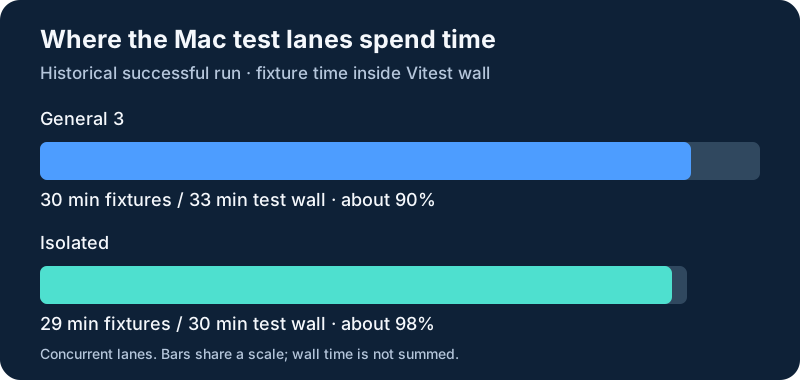
| Mac lane | Fixture time | Vitest wall | Share |
|---|---|---|---|
| General 3 | 30 min | 33 min | about 90% |
| Isolated | 29 min | 30 min | about 98% |
Inspect the successful GitHub Actions run. The exact interval, source and numeric values are in the downloadable method and data. This historical run does not qualify the new candidate.
Reuse work within the request
Four alternating baseline/candidate pairs used the same real private Git and preparation store, with controlled delivery, run and artifact witnesses. Output equality and unchanged fixture state were checked. One immediate redundant projection was removed; every new request still revalidates its inputs.
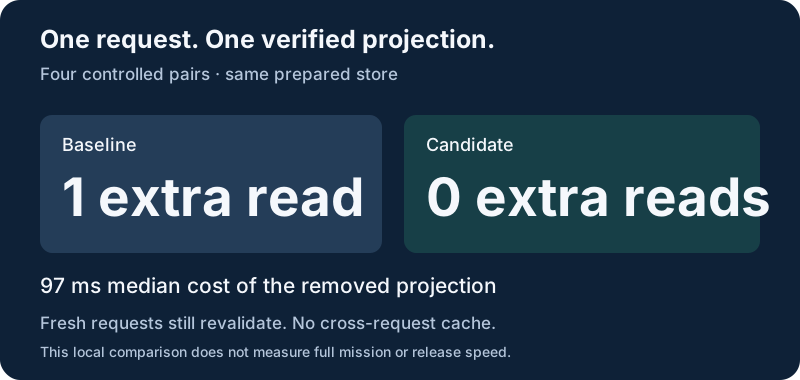
The separate real setup and mission tests passed all three cases, including restart, a second scope and Stop, at unchanged deadlines. They establish observed behavior; they do not establish a faster complete mission.
Let independent tool discovery start together
The candidate starts independent downstream MCP tool lists concurrently and merges responses in registry order. Deferred-response tests prove independent start without a fragile wall-clock threshold. Reverse completion, failed peers, native-name collisions and repeated fresh discovery are covered. There is no measured end-to-end server speed claim.
A candidate view of decision latency
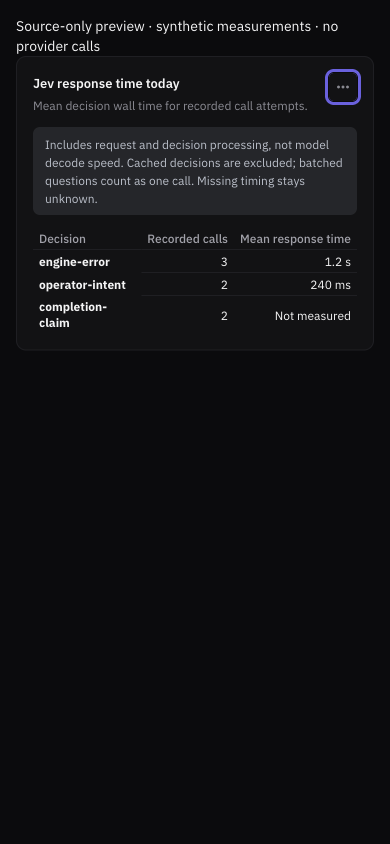
The candidate makes response-time scope visible: request and decision processing count; model decoding speed is a different metric. Cached decisions are excluded, and missing timing stays unknown.
The numbers in this screenshot are illustrative fixture values. They are deliberately excluded from the measured CSV and performance conclusions.
We are qualifying the new Phantom umbrella homepage separately. phm.dev currently serves Phantom Secrets; this appendix does not claim that its upcoming workbench scene is already live.
Method, source and downloadable data
No private prompts, account names, credit balances, customer records or provider credentials are included. Display quantities are rounded; downloadable CSV retains observed precision.
Source revisions and scope
Historical baseline source · 3.24.4 candidate source · Published 3.24.3 release
Local controlled observations use Node 22.22.3. Background load may affect timings. No matched end-to-end speed comparison, customer adoption result or billing outcome is claimed.